
TeenPatti – How To Play And Compare The 6 Decks Of Cards
TeenPatti is a three-card game originating in South Asia, known for its accessible rules. Each player receives three face-down cards and then takes turns deciding whether to continue, raise the bet, or fold. In this guide, PHTAYA bet explains the rules, hand rankings, and essential terminology that beginners should understand.
What is TeenPatti?
TeenPatti literally means three cards. The traditional game uses a standard 52-card deck without Jokers in its basic version. The number of participants typically ranges from three to six, depending on the rules of each table.

Before the cards are dealt, each player contributes an initial stake called the Boot. Each participant then receives three face-down cards and takes action in turn. Players can keep their cards hidden and play Blind or look at their cards before continuing as Seen.
A round ends when only one player remains without folding or when the last two players proceed to a Show to compare their hands. The winner receives the pot according to the table rules.
Hand rankings and how to compare their strength
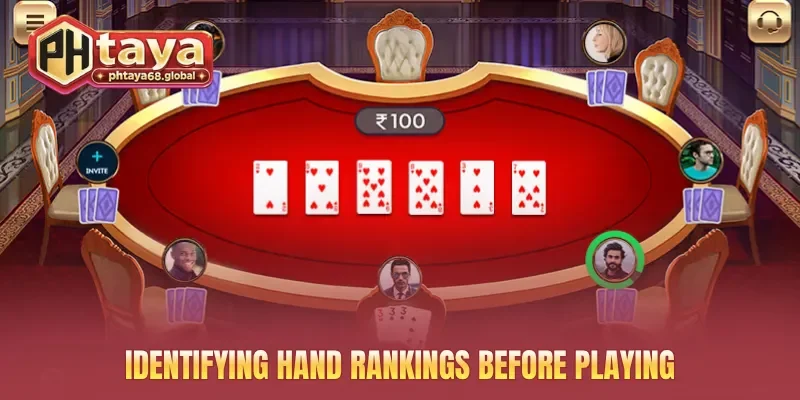
Before learning how to bet in TeenPatti, beginners should memorize the ranking of the six basic hand categories. These rankings determine the winner when two players enter a Show.
Trail – Three of a kind
Trail, also known as Trio, consists of three cards of the same rank. For example, three Aces form the strongest Trail in the commonly used ranking system, while three 2s form the lowest hand in this category.
Pure Sequence – A suited straight
A Pure Sequence consists of three consecutive cards of the same suit. For example, the 9, 8, and 7 of diamonds form a Pure Sequence. It is the second-strongest hand, ranking just below Trail.
Sequence – A straight of mixed suits
A Sequence also consists of three consecutive cards, but the cards do not need to share the same suit. For example, a 10-9-8 combination with three different suits still qualifies as a Sequence.
Color – Three cards of the same suit
Color consists of three cards of the same suit that do not form a consecutive sequence. When two players have Color, their cards are compared individually from highest to lowest.
Pair – One pair
A Pair in TeenPatti consists of two cards of the same rank and one unmatched card. If both players have a pair, the higher pair wins. If the pairs have the same rank, the remaining card is used to determine the winner.
High Card – A high-card hand
High Card applies when a player’s three cards do not form any of the combinations listed above. The highest card is compared first, followed by the second-highest and then the lowest card if necessary.
Note: The ranking of A-K-Q and A-2-3 can vary between game variants. Always check the table rules before playing.
Step-by-step guide to playing TeenPatti
After learning the hand rankings, beginners can follow the sequence of a standard round. Understanding each stage helps prevent confusion when making decisions during gameplay.
- Step 1: Place the Boot and receive cards. All participants contribute the agreed initial stake. The dealer then distributes three face-down cards to each player. No one may look at another player’s cards unless a valid Show takes place.
- Step 2: Choose Blind or Seen. Players in TeenPatti can keep their cards hidden and play Blind or look at all three cards to become Seen. These choices affect the minimum betting amount and subsequent decisions.
- Step 3: Take action in turn. When it is their turn, players can continue betting, raise the stake if the table allows it, or choose Pack to leave the round. Play continues in turn until only one player remains or the conditions for a showdown are met.
- Step 4: Show and determine the winner. When only two players remain, a Show may be requested according to the table’s rules. Both players reveal their cards and compare their hand rankings. The stronger hand wins the pot, while ties are handled according to the specific table rules.
Understanding Blind, Seen, and other important terms
These terms appear frequently in TeenPatti game interfaces. Understanding their meanings helps beginners identify their available actions and determine how their bets are calculated.
| Term | Meaning |
| Boot | The mandatory initial stake |
| Blind | Continuing to play without looking at your cards |
| Seen | Continuing after looking at your cards |
| Chaal | A bet made to remain in the round |
| Raise | Increasing the bet |
| Pack | Folding and leaving the current round |
| Show | Requesting a showdown to compare hands |
| Side Show | Requesting a private comparison with the previous player, if permitted |
| Pot | The total amount of money or chips in the round |
How to compare hands when two players request a Show
A Show is the stage at which players reveal their cards to determine the winner. The requirements for requesting a Show, the associated costs, and the procedures for handling ties may differ between tables, so players should review the rules before participating. When comparing TeenPatti hands, follow these steps:

- Compare the hand categories first, from Trail to High Card.
- If both hands belong to the same category, compare card values according to the relevant rules.
- For a Pair, compare the pair first and then the unmatched card.
- For Color or High Card, compare the cards from highest to lowest.
- If the hands remain equal, apply the table’s tie-breaking rules.
For example, Trail K-K-K beats a Pure Sequence of 9-8-7 in the same suit because Trail ranks higher. Similarly, a Pair of Aces generally beats a Pair of Queens, regardless of the unmatched cards in the two hands.
TeenPatti variants you should know
Beyond the traditional rules, TeenPatti has several variants that change hand rankings or introduce special mechanics. Players should not assume that every table follows the same rules.
- Muflis: This variant reverses the usual hand rankings, giving weaker hands an advantage under the table’s rules.
- Joker: Certain cards are designated as Jokers and can substitute for other cards according to the applicable rules.
- AK47: A popular variant that treats Aces, Kings, 4s, and 7s as special cards or Jokers, depending on the version.
- 999: A variant that uses a different scoring system and method of determining combinations from the traditional game.
Conclusion
TeenPatti is a three-card game with accessible basic rules, but choosing between Blind, Seen, Chaal, Raise, and Pack requires players to understand their hand and the current stakes. Learning the rankings from Trail to High Card is the first step toward deciding when to continue and when to fold. Visit the tables at PHTAYA to start exploring this classic card game.